
Brian May’s Guitar Rig: Red Special, Treble Booster and the AC30 Connection
Brian May’s guitar sound is a useful reminder that a distinctive rig does not have to start with a pedalboard the size of a kitchen table. At its heart sits a particular relationship: the Red Special, a treble booster and a Vox AC30. The interesting part is how those pieces work together, not how many boxes you can collect.
This guide separates that core sound from the larger stage setup documented in a 2014 interview with May and his guitar tech Pete Malandrone. It is a historical rig breakdown, not a claim to list every item in his current touring system.
The guitar: a homemade original, not an off-the-rack starting point
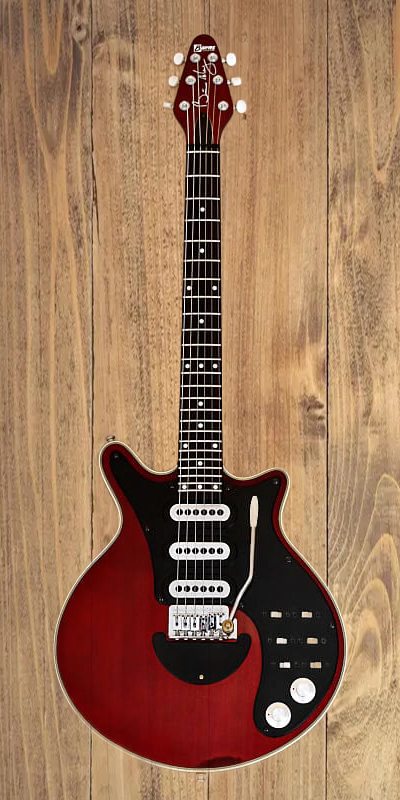
Brian and his father Harold began building the original Red Special in 1963, taking more than a year to finish it. Its construction included wood from an old fireplace mantel for the neck and hand-shaped mother-of-pearl buttons for the position markers. May’s official Red Special book documents that resourceful process. The appeal is not simply that the instrument looks unusual: it was built around its player’s ideas rather than bought and accepted as-is.


Those six switches are more than decoration
The modern BMG Special makes the design’s logic easy to understand. Three switches turn its pickups on and off individually; another three reverse their phase. Its Tri-Sonic-style single coils are wired in series, unlike the familiar parallel combinations on many three-pickup guitars. BMG’s own support guide explains how this gives the combined signal more body and output.
For a practical starting point, BMG identifies bridge and middle together, in phase, with the full sound May favors for much rhythm work. Change the relative phase of two active pickups and the result becomes leaner and more pointed. Flipping a phase switch with only one pickup selected will not produce that same contrast. The switches are a way of changing the sound before it reaches the amplifier, rather than asking an EQ pedal to solve everything later.


The treble booster and AC30 are a partnership
Guitar builder Greg Fryer describes a frequently used studio foundation as Red Special into treble booster into AC30, with effects usually added through the mixing desk. His historical account also distinguishes the early Dallas Rangemaster period from later boosters. That matters: there is no single pedal model that should be credited with every Queen-era guitar sound.
The useful lesson is to audition the booster and amplifier together. Judge the complete sound with a musical phrase, not just the brightness of a pedal switched on in isolation. A setting that feels excessive into a clean practice amp may behave very differently into a driven amp model. Start with conservative volume, then adjust gain and output separately.


Why the live rig spreads across three amps
In the 2014 rundown, May’s three working AC30s form a wet/dry/wet setup: the center carries the dry guitar, while the outside amps carry different delayed signals. The documented effects include a strap-mounted Fryer booster, rack wah and two TC Electronic G-Major 2 units, with delays set to 800 and 1,600 milliseconds. These are values from that particular rig, not universal settings for every Queen song.
The layout preserves a direct center sound while echoes create width. It also explains why simply adding more distortion is not the answer to the rig’s scale. May discusses using his guitar’s volume control to manage the driven sound, and his sixpence pick is another part of the physical interaction with the strings.
Watch the original Premier Guitar rig rundown with Brian May and Pete Malandrone. It is worth seeing the actual equipment rather than relying on a shopping list.
Try the idea without building a stadium rig
Here is our suggested practice experiment, not a transcription of May’s personal settings:
- Start dry. Choose an AC30-style amp sound and turn off delay, reverb and modulation.
- Add the booster. Compare the attack and sustain at a similar listening volume, so louder does not automatically win.
- Use the guitar controls. Play the same chord and single-note line with the volume rolled back, then opened up. Listen for a usable range rather than one spectacular preset.
- Add space last. Bring in a modest delay level. Keep the original note intelligible before exploring longer, overlapping repeats.
For a compact example of this design philosophy, Vox’s MV50 Brian May combines AC30-inspired voicing with a switchable KAT treble booster and a cabinet-simulated headphone/line output. That does not turn it into the full three-amp stage rig; it shows which ingredients Vox and May chose to retain when shrinking the concept.
The takeaway: build the core voice first, then build the space around it. For another approach to arranging a big guitar sound, read our Johnny Marr GT-100 rig breakdown, or explore the artist rig archive.