
Johnny Marr’s GT-100 Rig: Big Guitar Textures, Less Pedalboard Tap-Dancing
You’ve got the intro sound ready. The verse needs something cleaner. The chorus wants a different delay, and now you’re supposed to sing.
Suddenly, your pedalboard feels less like a creative tool and more like a practical driving test.
That’s what makes Johnny Marr’s GT-100-era approach worth a closer look. This isn’t simply a story about a famous guitarist using a multi-effects unit. It’s about organizing complicated sounds so the audience hears the song instead of watching somebody operate equipment.
For this Rig of the Week, we’re looking at an earlier chapter of Marr’s live setup, not presenting a supposed inventory of everything he uses today.


The clever part wasn’t the box. It was the preparation.
In his BOSS Tone Radio interview, Marr described recreating sounds from his analog pedalboard inside a GT-100. He programmed the processor against his studio setup, then used external controls to move between patches while performing. Singing was central to that decision: he wanted to stay engaged with the audience, not spend the show staring at his shoes. Read Marr’s BOSS interview.
That’s the useful idea here. A complicated sound doesn’t have to require a complicated performance.
Think of a preset as a scene in a song rather than a collection of effects you happen to like. The verse scene might be dry and close. The chorus might open up. A brief transition could need something stranger. Planning those changes gives the effects a job.
Otherwise, it’s very easy to build a spectacular patch that has absolutely nowhere to go. We’ve all met that patch. It sounds enormous until the drummer starts.
Where the Johnny Marr Jaguar fits
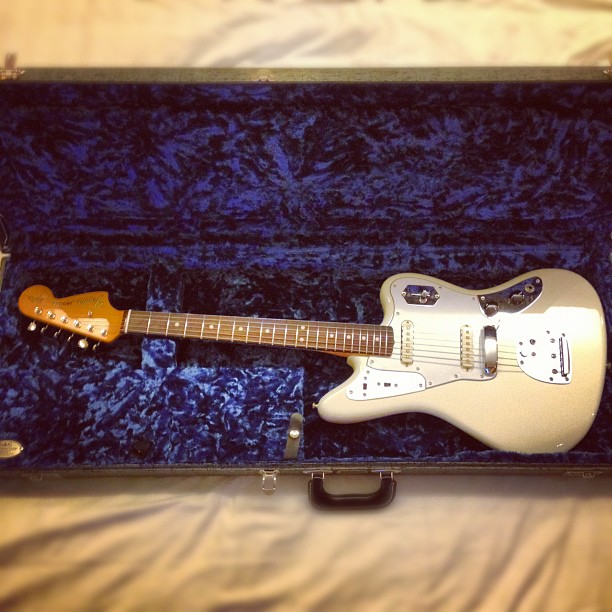
Fender introduced the original Johnny Marr signature Jaguar in 2012. Its features included custom-wound Bare Knuckle single-coil pickups, a four-position selector, and two bright switches. The selector offered the pickups individually, together in parallel, or together in series. Fender also specified bridge and tremolo modifications, rather than simply adding a signature to an otherwise standard Jaguar. Fender’s original announcement.
The practical lesson is to explore the guitar before building another preset.
Play the same short part through each pickup selection. Listen for whether the notes separate, whether the lower strings crowd the chord, and whether the upper notes need softening. Make that choice before asking an EQ or modulation effect to solve everything.
You don’t need a signature model to try this. You need a repeatable musical phrase and the patience to change one thing at a time. Less glamorous than ordering another pedal, admittedly. Considerably easier to fit on the kitchen table.


What the GT-100 brought to the arrangement
The GT-100 combined amp modeling and effects, including delay, chorus, reverb and overdrive/distortion. Its A/B divider supported two signal paths, and patches could be organized for performance. BOSS now lists the model as discontinued, so this is a look at a documented creative approach, not a recommendation to buy a newly released product. BOSS GT-100 information.
We’re not claiming a precise Marr signal chain here. The interview explains his workflow, but it doesn’t document every connection and setting.
The useful takeaway is the workflow: prepare the sounds, then make the transitions easy enough to handle while singing.
Try the idea with the gear you already own
Here’s our suggested exercise, inspired by that workflow. These are not Johnny Marr’s personal settings.
Start with one clean sound. Turn off the decorative stuff. Play a chord figure with both low and high notes. Adjust until the part makes sense without effects. If the dry guitar is muddy, a cathedral-sized reverb probably isn’t coming to the rescue.
Build a contrasting second sound. Keep the same basic level, then add one obvious change: a little drive, some modulation, or a different ambience. Play the actual transition between the two. A beautiful standalone sound can still be wrong for the next section.
Give delay a supporting role. Try a short rhythmic phrase and listen to what the repeats do between your notes. Reduce the effect if it starts arguing with your picking. The empty spaces are part of the arrangement too.
Rehearse the switching. Practice the whole section, including the foot movement. If you sing, add the vocal. A preset that requires three last-second decisions is not quite finished.
Record a rough pass. A phone recording won’t tell you everything, but it can expose an awkward volume jump or an effect that swallows the part. Listen once without watching yourself play.
The takeaway: build a rig around the song
The most interesting question isn’t whether an analog board beats a digital processor. It’s whether your setup lets you perform the music you meant to make.
Marr’s documented approach offers a useful challenge: do the detailed sound-building beforehand, then make the performance simpler.
Start with one song. Build only the sounds it actually needs. Leave room for the guitar, the vocal and the rest of the band.
Your shoes have had enough stage time.
Keep exploring: Browse the Guitar Rigs archive for more artist setups and ideas to try in your own playing.